Why We F*cking Hate MLM Schemes:

The Hidden Impacts on Families (and Children!)
I was recently given the book The Business of the 21st Century by Robert T. Kiyosaki. After an eloquent speech about business ownership, I sensed I was about to be pitched into an MLM scheme. Reading this book illuminated how women are drawn into the alluring promise of freedom and financial stability, often through sophisticated manipulation and grooming tactics. Alarmingly, research indicates that 74% to 95% of MLM participants are women, with vulnerable communities—particularly those from low socio-economic backgrounds—being specifically targeted (Higgins et al., 2018). Those at the top of these pyramids seem to grasp the essence of entrepreneurship, yet they sell a dream that is rarely financially viable for the majority, raising serious ethical questions.
As a mental health practitioner working with vulnerable children and families, I often witness the fallout of these schemes. Women, frequently the primary caregivers, find their involvement in MLMs weaponised against them during custody battles, labeled as irresponsible or financially incapable of providing for their children. This narrative serves to reinforce patriarchal views and damaging stereotypes that undermine the strength and capabilities of women (Federal Trade Commission, 2011).
Many participants talk about how they feel encouraged to “drink the Kool-Aid,” buying into the belief that success is just around the corner. Grooming tactics seem to be employed to recruit participants into these schemes, gradually leading them to adopt the beliefs and values of the organisation. I have witnessed first hand how this emotional coercion traps women in a cycle of dependency and self-doubt. Statistically, 99% of all MLM participants will not make any financial gain from their involvement, raising ethical concerns about these business models (Hoffman, 2020).
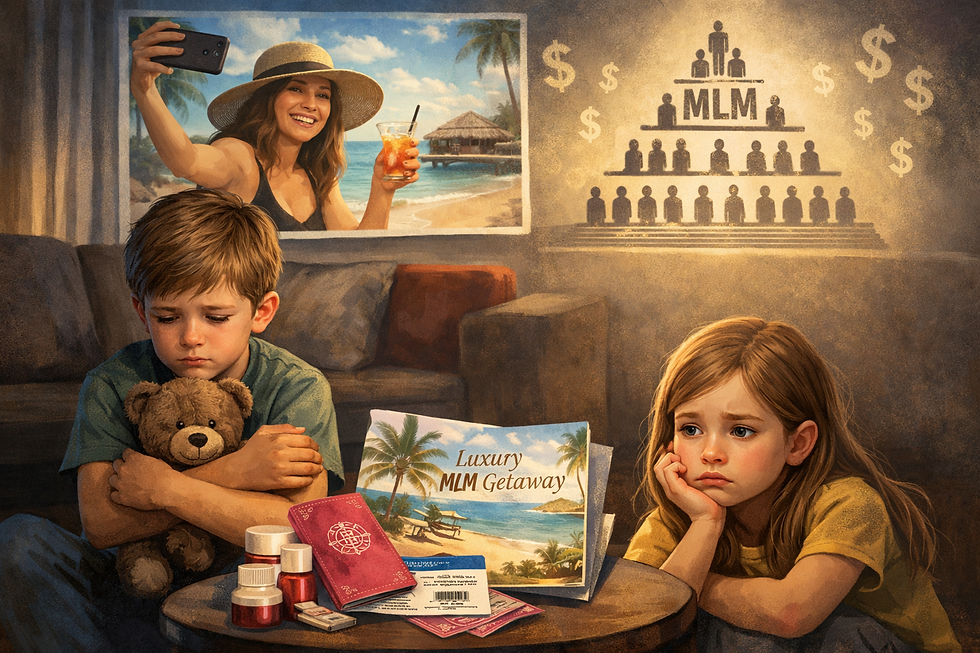
In my professional experience working with children, I have seen how MLM schemes can disrupt family bonds and emotional security. Many children feel rejected and overlooked when their primary caregiver prioritises overseas MLM trips—often marketed as “child-free holidays”—over time at home. While we rightly encourage women and mothers to pursue self-care and meaningful careers, research consistently shows that children’s wellbeing is closely tied to stable, responsive caregiving and a sense of emotional security. When parental absence is frequent and/or accompanied by stress and financial instability, children may experience feelings of uncertainty, rejection, and anxiety. Over time, these pressures can be internalised, shaping their beliefs about money, work, and self-worth in harmful ways (Baker, 2018).
We must challenge the narratives perpetuated by MLMs and support one another in breaking free from these harmful cycles. By fostering financial literacy and open dialogues about the manipulation inherent in these schemes, we can create a more equitable environment for families. Let’s advocate for a future where women are empowered, educated, and actually free to make informed choices about their financial destinies.
References
Baker, D. (2018). The impact of financial literacy on economic well-being. Journal of Economic Perspectives, 32(2), 83–106. https://doi.org/10.1257/jep.2018.0017
Federal Trade Commission. (2011). Report on Multi-Level Marketing. Retrieved from https://www.ftc.gov
Higgins, J. P., & McKenzie, J. E. (2018). The prevalence of women in multi-level marketing: A systematic review. Journal of Business Ethics, 149(1), 1-18. https://doi.org/10.1007/s10551-018-4005-0
Hoffman, A. (2020). The Money Pit: Multi-Level Marketing and the Financial Impact on Participants. Journal of Consumer Research, 47(3), 485-495. https://doi.org/10.1093/jcr/ucaa005
Organisation for Economic Co-operation and Development. (2020). Financial literacy and consumer protection: Evidence from the OECD/INFE 2018 International Survey of Adult Financial Literacy. Retrieved from https://www.oecd.org


Comments